

Video games have come a long way since the days of simple two-dimensional sprites bouncing across a screen. One of the most profound forces driving that evolution is artificial intelligence — the technology that breathes life into the digital worlds we explore, the enemies we fight, and the companions we rely on. AI in video games isn’t a new concept, but the speed at which it has advanced over the past two decades has fundamentally changed what it means to sit down and play. From the rudimentary logic trees of early arcade machines to the sophisticated, adaptive systems powering today’s open-world epics, AI has quietly become one of gaming’s most important storytellers.
A Brief History of AI in Video Games
To truly appreciate where AI in gaming stands today, it helps to understand where it started. The history of artificial intelligence in video games stretches back further than most people realise — all the way to the earliest days of interactive entertainment.
The Arcade Era: Rules and Patterns
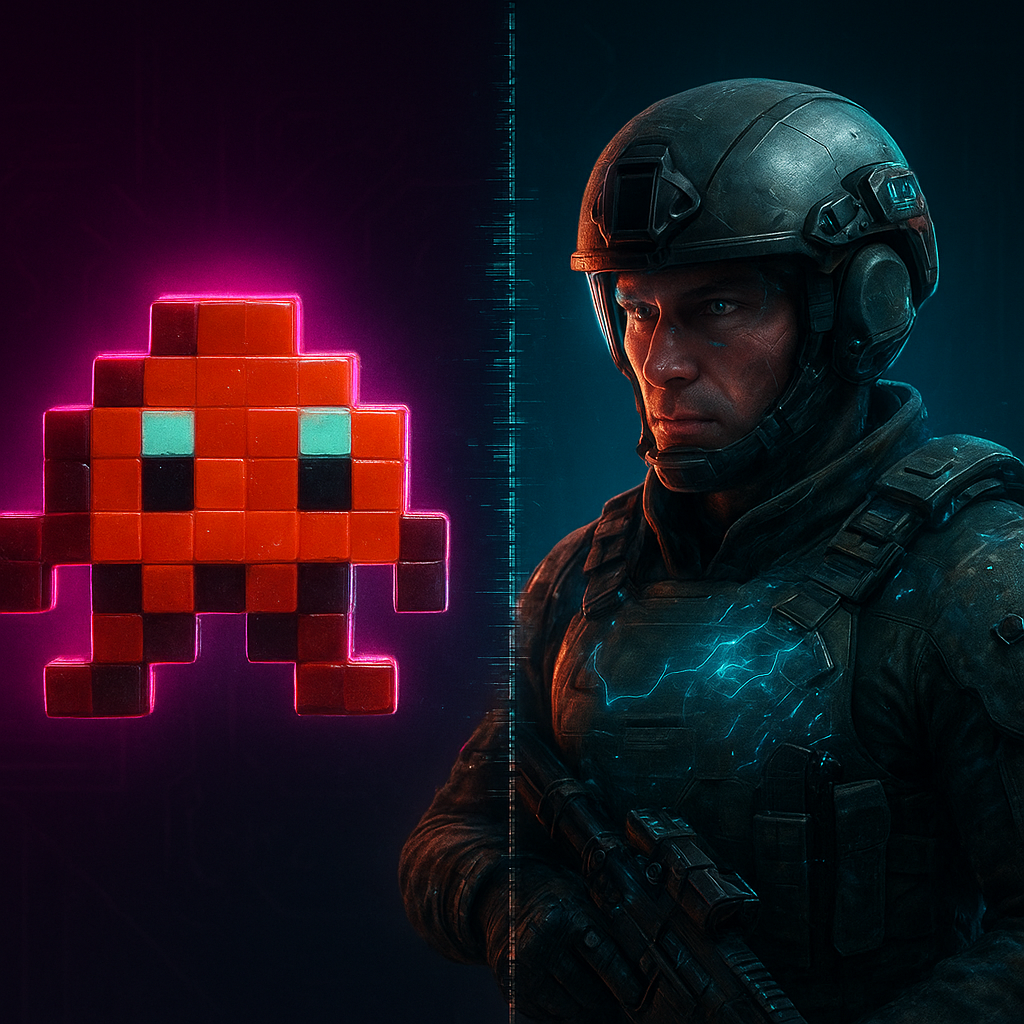
In the 1970s and early 1980s, game AI was essentially a set of hardcoded rules. Games like Space Invaders (1978) featured enemies that moved in predictable, pre-programmed patterns. There was no real intelligence at work — just a loop of instructions telling sprites where to go and what to do. Yet even this simple form of AI was enough to captivate players and lay the groundwork for everything that followed.
Pac-Man (1980) is often cited as one of the earliest examples of AI with genuine personality. Each of the four ghosts — Blinky, Pinky, Inky, and Clyde — had a distinct behavioural algorithm. Blinky would directly chase Pac-Man, while Clyde would wander seemingly at random. This gave players the impression of competing against different characters with different strategies, even though the underlying logic was relatively straightforward.
The 1990s: Finite State Machines and Smarter Enemies
The 1990s brought significant leaps forward. As hardware became more powerful, developers could implement more sophisticated decision-making systems. Finite state machines (FSMs) became a staple of game AI design — systems where characters could exist in different “states” (patrolling, alert, attacking, fleeing) and transition between them based on player actions.
Games like Doom (1993) and Quake (1996) used FSMs to create enemies that would hunt the player down, react to gunfire, and even attempt to flank them. It wasn’t truly intelligent behaviour, but it felt dynamic and reactive enough to make combat genuinely tense. Meanwhile, strategy games like StarCraft pushed AI design in a completely different direction, requiring computer opponents to manage economies, build armies, and respond to complex player strategies.
The Modern Era: When AI Started Feeling Real
The 2000s marked a turning point. Processing power had grown to the point where developers could move beyond simple state machines and begin experimenting with more nuanced systems. Behaviour trees, pathfinding algorithms, and machine learning concepts started filtering into mainstream game development.
Halo and the Behaviour Tree Revolution
Halo: Combat Evolved (2001) is widely credited with setting a new standard for enemy AI in first-person shooters. The Covenant soldiers in Halo would take cover, flank the player, throw grenades to flush them out of hiding spots, and even retreat when outgunned. Players weren’t just mowing down scripted enemies — they were engaging in something that felt closer to a genuine tactical encounter. This was largely thanks to an early implementation of behaviour trees, a hierarchical decision-making structure that allowed for more nuanced and believable reactions.
The Sims and Emergent AI
Not all groundbreaking AI came from action games. The Sims (2000) introduced millions of players to the concept of emergent behaviour — where complex, believable scenarios arise from a set of relatively simple rules. Sims had needs, desires, and social relationships that interacted in unpredictable ways, creating stories that no developer explicitly programmed. This emergent quality became one of the most exciting frontiers in game AI, and its influence can still be felt in everything from RimWorld to Dwarf Fortress.

F.E.A.R. and Tactical AI
Perhaps no game demonstrated the possibilities of AI-driven combat quite like F.E.A.R. (2005). Its enemy soldiers used a system called Goal-Oriented Action Planning (GOAP), which allowed them to dynamically assess their situation and choose from a range of possible actions to achieve their objectives. They communicated with each other, coordinated flanking manoeuvres, and responded intelligently to the player’s tactics. Gaming journalists at the time were genuinely astonished, and many still consider F.E.A.R.’s AI to be among the finest ever put into a video game.
How AI Shapes the Player Experience Today
Modern games use AI in ways that go far beyond simply making enemies harder to beat. Today’s AI systems influence nearly every aspect of how a game feels to play, from the behaviour of non-player characters (NPCs) to the procedural generation of entire worlds.
Dynamic Difficulty Adjustment
One of the most player-friendly applications of modern game AI is dynamic difficulty adjustment (DDA). Rather than forcing players to choose a fixed difficulty level at the start of a game, DDA systems monitor how well a player is performing and subtly adjust the challenge in real time. If you’re breezing through a section, enemies might become slightly more aggressive or accurate. If you’re struggling, the game might offer additional resources or reduce enemy health. Games like Resident Evil 4 pioneered this approach, and it’s now common across many genres.
Procedural Generation and AI-Driven Worlds
Procedural generation — using algorithms to create content rather than designing it by hand — has transformed what’s possible in game development. Titles like No Man’s Sky use procedural systems to generate entire solar systems, each with unique planets, flora, fauna, and weather patterns. More recent games are beginning to integrate machine learning into these systems, allowing for content that not only varies procedurally but also adapts based on player behaviour. This kind of innovation is part of a broader shift in open world game design that has redefined player expectations over the past two decades.
NPC Behaviour and Living Worlds
The NPCs in today’s most ambitious games are a far cry from the static quest-givers of older titles. Games like Red Dead Redemption 2 feature NPCs with daily routines, memories of past interactions with the player, and the ability to react emotionally to events in the world. This creates a sense of inhabiting a living, breathing world rather than simply playing through a pre-written script. Rockstar’s AI systems track how players have behaved in towns — whether they’ve been violent, generous, or reclusive — and adjust NPC reactions accordingly.
Generative AI: The Next Frontier
The arrival of large language models and generative AI tools has opened up possibilities that would have seemed like science fiction just a few years ago. Developers are beginning to explore how generative AI can be used to create dynamic, responsive dialogue for NPCs — allowing characters to hold genuine conversations with players rather than cycling through pre-written lines.
In 2023, Nvidia demonstrated their ACE (Avatar Cloud Engine) technology, which uses AI to generate real-time, contextually appropriate dialogue for game characters. The demo showed an NPC responding naturally to player questions without any pre-scripted responses. Several studios are now exploring similar technology, and it’s widely anticipated that within the next generation of consoles, truly conversational NPCs could become a standard feature.
Generative AI is also being explored for:
- Procedural storytelling — where narrative branches and character motivations are generated dynamically based on player choices
- Personalised game content — environments, quests, and characters tailored to individual playstyles
- Automated playtesting — AI agents that can play through thousands of hours of game content to identify bugs and balance issues
- Realistic animation — machine learning models that generate natural-looking character movement without the need for motion capture
The Controversy Surrounding AI in Gaming
Not everyone is enthusiastic about AI’s expanding role in the industry. The use of generative AI tools has sparked significant debate, particularly around questions of creativity, labour, and intellectual property.
Many artists, writers, and voice actors have raised concerns about AI systems being trained on their work without consent or compensation. High-profile disputes over the use of AI-generated voices and AI-assisted art in games have made headlines, and several major industry unions have taken formal positions against certain applications of the technology. The Screen Actors Guild-American Federation of Television and Radio Artists (SAG-AFTRA) reached a landmark agreement with a number of game studios in 2024 that established protections for performers against unconsented AI voice replication.
There are also philosophical questions about what gets lost when game worlds are shaped by algorithms rather than human designers. Procedurally generated content can feel hollow in ways that handcrafted experiences do not — a criticism levelled at several high-profile games in recent years. Striking the right balance between AI-driven efficiency and human creative vision remains one of the central challenges facing the industry.
What Does AI Mean for the Future of Gaming?
The trajectory of AI in gaming points towards experiences that are more personalised, more reactive, and more immersive than anything currently possible. Some researchers and developers envision a future where game worlds respond so fluidly to player behaviour that the line between authored narrative and emergent experience becomes almost indistinguishable.
AI-driven games could one day remember every choice a player has ever made — not just within a single playthrough, but across years of gaming — and use that data to craft experiences that feel genuinely unique. Characters might develop relationships with players over time in ways that feel earned rather than scripted. Entire game worlds could evolve in response to the collective actions of a player community, with AI systems managing the consequences of thousands of simultaneous decisions.
For competitive gaming, AI presents both opportunities and challenges. AI-powered coaching tools are already helping players improve their skills in games like League of Legends and Valorant, analysing replays and offering strategic advice. At the same time, AI-assisted cheating remains a persistent concern for developers and competitive communities alike.
Conclusion
Artificial intelligence has been part of video gaming since its earliest days, but its role has expanded dramatically — from simple pattern-based enemies in 1980s arcades to the adaptive, generative systems shaping the next generation of interactive entertainment. The history of AI in games is really the history of developers pushing at the boundaries of what computers can simulate, and what players can believe.
Today’s game AI creates worlds that feel alive, enemies that feel cunning, and stories that feel personal. Tomorrow’s AI promises experiences that adapt in real time to who you are as a player, blurring the boundaries between game design and genuine intelligence. The controversies are real and the questions about creativity and labour deserve serious consideration — but so does the extraordinary potential of this technology to transform how we experience play. Understanding the history and mechanics of AI in games gives every player a richer appreciation of the craft that goes into the worlds they inhabit.