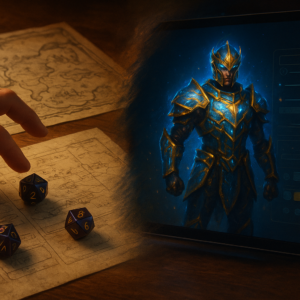

Sandbox games occupy a fascinating space in the gaming world. Unlike linear titles that guide players through a fixed narrative, sandbox environments hand the reins over entirely — offering tools, terrain, and possibility without a rigid destination. Yet despite this freedom, players don’t simply wander aimlessly. They set goals, build communities, develop rituals, and return day after day. Understanding what drives player behaviour and engagement in sandbox games reveals something profound not just about game design, but about human psychology itself.
From the obsessive architect in Minecraft to the ruthless empire-builder in Dwarf Fortress, the motivations behind sandbox play are surprisingly layered. This article explores those motivations, examines what keeps players hooked, and unpacks some of the most common questions people have about player behaviour in open-world and sandbox environments.
What Makes Sandbox Games Different From Other Genres
Before diving into behaviour, it’s worth establishing what sets sandbox games apart. A sandbox game — sometimes called an open-world or emergent gameplay title — is defined by its lack of prescribed objectives. Players are given agency to create, destroy, explore, and interact without being funnelled towards a single outcome.
Games like Minecraft, Terraria, Roblox, Garry’s Mod, and No Man’s Sky all fall under this umbrella, though they differ wildly in tone and mechanics. What unites them is the principle that the player’s imagination and decision-making are the primary drivers of the experience.
This distinction matters enormously when analysing engagement. In a narrative-driven game, engagement is often tied to story momentum — players push forward to find out what happens next. In a sandbox, engagement must come from somewhere else entirely. And that’s where things get interesting.
The Psychology Behind Sandbox Engagement
Autonomy, Mastery, and Purpose
Decades of psychological research point to three core human needs that, when met, produce deep, sustained motivation: autonomy, mastery, and purpose. Sandbox games are uniquely positioned to satisfy all three simultaneously.
Autonomy is perhaps the most obvious. Players choose what to build, where to explore, and how to interact with the world. That sense of ownership over one’s experience is enormously compelling. Research into self-determination theory consistently shows that people are more engaged when they feel in control of their choices.
Mastery emerges naturally through sandbox mechanics. Learning to optimise a farm in Stardew Valley, engineer a complex redstone circuit in Minecraft, or manage competing factions in a city-builder creates a satisfying progression curve — even when there’s no explicit level-up system.
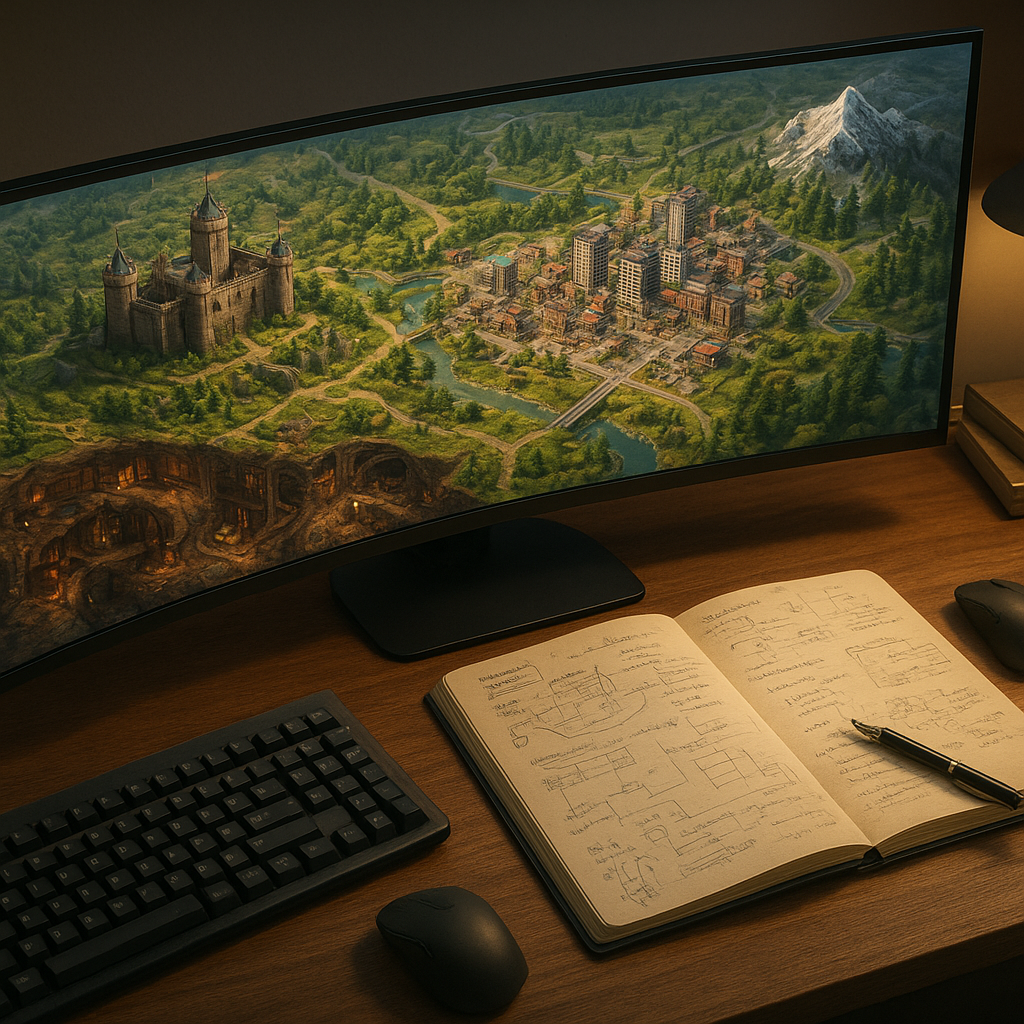
Purpose is perhaps the most nuanced. Sandbox games don’t hand players a purpose — they must construct one. Interestingly, this is often more motivating than being assigned a goal. When a player decides they want to recreate an entire medieval city from scratch, that self-determined mission carries far more emotional weight than a quest marker ever could.
The Role of Emergent Storytelling
One of the most compelling forces in sandbox engagement is emergent narrative — the unscripted stories that arise naturally through play. A player doesn’t simply “build a house” in Minecraft; they survive a terrifying first night, lose their torch, panic, and barely make it to dawn. That story becomes theirs. It’s memorable precisely because it wasn’t scripted.
This emergent quality keeps players coming back because every session has the potential to produce something genuinely unexpected. The unpredictability functions almost like a reward system, triggering curiosity and anticipation in ways that more linear games struggle to replicate over time.
What Does “Player Engagement” Actually Mean?
Player engagement is a term that gets thrown around frequently, but it’s worth defining properly. In the context of gaming, player engagement refers to the degree to which a player is absorbed, invested, and motivated to continue interacting with a game. It encompasses both emotional involvement (how much a player cares about the experience) and behavioural commitment (how often and how long they play).
Engagement is not the same as addiction, though the two can overlap. True engagement involves positive emotional states — curiosity, satisfaction, creativity, excitement. It’s what makes a player genuinely reluctant to stop playing because they’re enjoying themselves, not because they feel compelled to chase a reward loop.
In sandbox games specifically, engagement tends to manifest through:
- Extended play sessions driven by self-set goals
- Community participation — sharing creations, collaborating, or competing
- Creative investment in the game world
- Return visits motivated by wanting to continue personal projects
Player Archetypes in Sandbox Environments
Not all sandbox players are motivated by the same things. Richard Bartle’s famous player typology — originally developed for MUDs (multi-user dungeons) in 1996 — remains remarkably relevant today. His four archetypes break down as follows:
- Achievers – Players motivated by accomplishment. In a sandbox, they’ll set increasingly ambitious build goals or grind for rare resources.
- Explorers – Players driven by discovery. They map every cave, test every game mechanic, and push the boundaries of what’s possible.
- Socialisers – Players for whom the community is the game. They collaborate, trade, and build relationships with other players.
- Killers – Players motivated by domination and competition. In sandbox PvP environments, they introduce conflict and rivalry that adds tension to the world.
Most players don’t fit neatly into one category — they blend traits depending on their mood and the specific game context. Understanding these archetypes helps explain why a sandbox game with robust social features retains players that a purely solo-focused equivalent might lose.
The 80/20 Rule in Game Development
The 80/20 rule in game development — also known as the Pareto Principle applied to gaming — suggests that roughly 80% of a game’s content is experienced by only 20% of its players. Conversely, around 80% of players only engage with 20% of the available content.
In sandbox games, this has fascinating implications. Developers might spend enormous resources building deep crafting systems, intricate lore, or complex biome variations — only to find that the majority of players spend most of their time in a relatively small portion of the game world doing a handful of core activities.
This isn’t necessarily a failure. In sandbox design, the existence of depth — even when most players don’t access it — contributes to a sense of world richness. Players who know that more exists, even if they haven’t explored it, feel the world is larger and more alive. The 80/20 rule in this context suggests that perceived depth can be as valuable as explored depth.
The 40 Second Rule in Gaming
The 40 second rule is a principle in game design that suggests core gameplay loops should cycle roughly every 40 seconds — delivering a meaningful moment of satisfaction, tension, or reward within that timeframe. The idea is that this interval aligns with natural human attention rhythms and keeps players engaged without overwhelming them.
In sandbox games, the 40 second rule manifests differently than in action titles. Rather than a combat loop or a puzzle reset, it might appear in the satisfying rhythm of mining and collecting resources, placing blocks and seeing immediate visual feedback, or checking back on a farm crop and finding it ready to harvest. These micro-moments of reward are stitched together across longer play sessions, maintaining engagement even when no dramatic events are occurring.
Game designers who understand this principle build sandbox environments that feel consistently rewarding — not just at major milestones, but in the quiet, repetitive moments that make up the bulk of play time.
Is Gamer Rage a Red Flag?
Gamer rage — the frustration, anger, or emotional outbursts that players sometimes experience during play — is a genuinely complex topic. In sandbox games, it tends to arise less from difficulty spikes (as those are often self-imposed) and more from social friction: griefing, stolen builds, or server crashes wiping hours of progress.
So, is gamer rage a red flag? The honest answer is: it depends entirely on context and frequency. Occasional frustration during an emotionally invested gaming session is entirely normal and arguably reflects healthy engagement — it means the player cares. Research in psychology suggests that brief emotional responses to setbacks are a natural part of any goal-directed activity.
However, persistent, intense rage — particularly when it spills into verbal abuse of other players, destruction of communal spaces in multiplayer sandboxes, or real-world distress — does warrant attention. In multiplayer sandbox communities especially, unchecked rage behaviour can be destructive to the social fabric that makes those games worth playing. Many sandbox communities have developed their own moderation cultures to address this, recognising that the social environment is as important as the game environment itself.
What Keeps Players Coming Back: Retention in Sandbox Games
Long-term retention in sandbox games is driven by a combination of factors that reinforce one another over time:
- Investment – The more a player builds, the more they have to lose and to protect. Emotional investment in a created world is a powerful retention force.
- Community – Multiplayer sandbox games with healthy communities retain players far longer than solo equivalents. Social ties create external motivation to return.
- Content updates – Regular additions of new biomes, mechanics, or items give players fresh reasons to explore content they’ve outgrown.
- Creative momentum – Players mid-project are far more likely to return than those who’ve just completed something. The sense of unfinished business is a powerful hook.
- Personalisation – The ability to make a game world feel distinctly one’s own — through unique builds, custom rules, or server communities — creates a sense of ownership that’s difficult to abandon.
The Intersection of Analytics and Player Behaviour
Modern game developers increasingly rely on player behaviour analytics to understand how people actually interact with their games. Heatmaps showing where players spend most of their time, drop-off analysis revealing where engagement fades, and session length data all inform design decisions in ways that gut instinct alone cannot.
For sandbox games, this data presents unique challenges. Because players can go virtually anywhere and do virtually anything, the data is enormously varied. However, patterns do emerge — certain biomes get visited more frequently, specific crafting systems see disproportionate engagement, and some mechanics go almost entirely unused.
Understanding these patterns doesn’t mean stripping out underused content. Sometimes, as the 80/20 rule suggests, the value is in the possibility rather than the engagement itself. But analytics help designers understand where friction exists — where players get confused, lose interest, or disengage — allowing for more targeted improvements.
Conclusion
Player behaviour in sandbox games is shaped by a rich interplay of psychological needs, game design principles, social dynamics, and personal motivation. Unlike linear games that direct engagement through story progression, sandbox titles must earn and sustain attention through freedom, feedback, and community. When they do it well, the results are some of the most enduring and deeply loved games ever created.
From the psychological satisfaction of autonomy and mastery to the subtle rhythms of the 40 second rule, from player archetypes to the nuanced reality of gamer rage — every dimension of sandbox engagement points towards the same truth: people don’t just play these games. They live in them, at least for a while. And understanding why helps us appreciate not just the games themselves, but what they reveal about the humans who play them.