
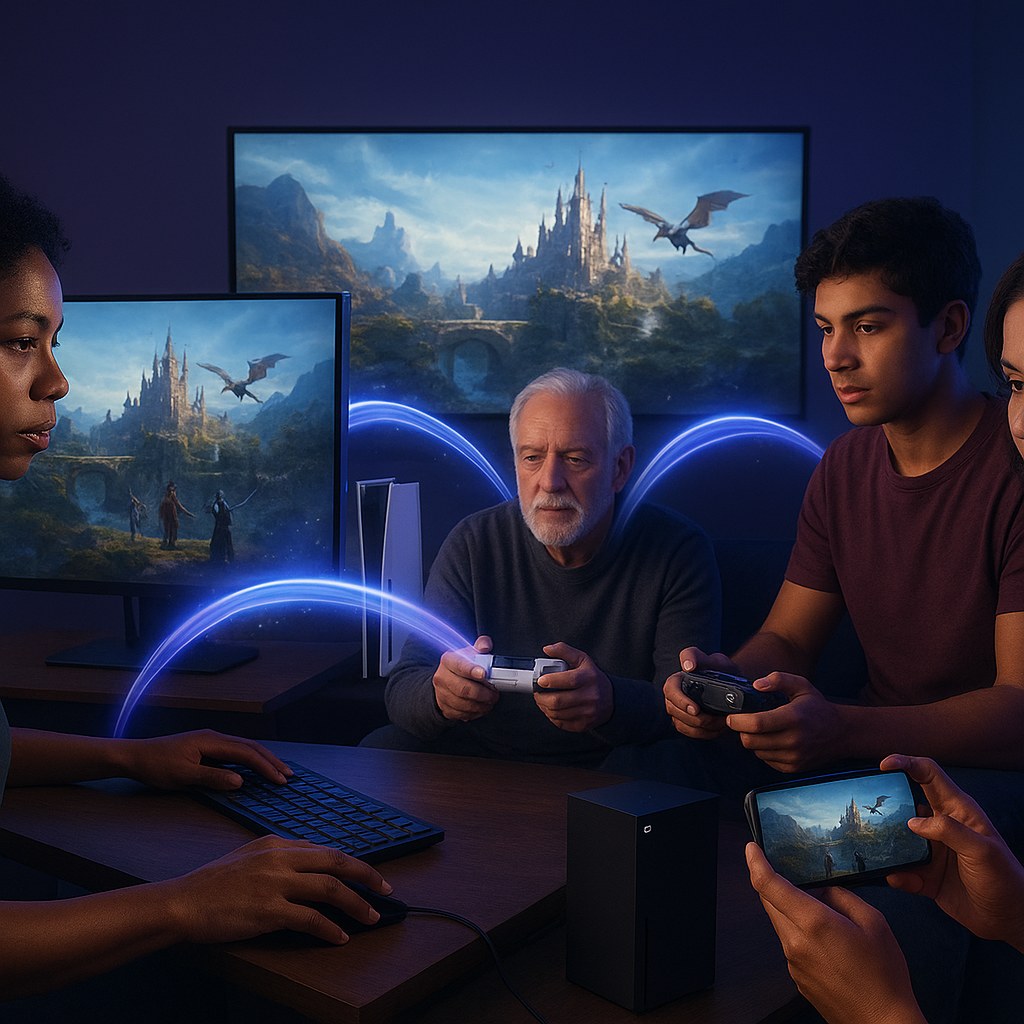
Remember when buying a game meant first checking which console your mates owned? For decades, multiplayer gaming was defined by invisible walls. PlayStation players couldn’t touch Xbox players. PC gamers existed in their own ecosystem. Nintendo fans were off doing their own thing entirely. Then, almost without anyone noticing the exact moment it happened, those walls came tumbling down.
Crossplay — the ability for players on different platforms to compete and cooperate in the same matches — has gone from a pipe dream to an industry standard in less than a decade. Today, it’s genuinely surprising when a major multiplayer title launches without it. So how did we get here, and what does it mean for the future of gaming?
What Exactly Is Crossplay?
Crossplay (or cross-platform play) allows gamers using different hardware — PlayStation, Xbox, Nintendo Switch, PC, and increasingly mobile — to play together in the same online sessions. It’s distinct from cross-progression, which lets you carry your saves, unlocks, and purchases between platforms, though the two features often arrive hand in hand.
The concept sounds simple. The execution, historically, was anything but.
The Walled Garden Era
For most of gaming history, platform holders had every incentive to keep players locked in. If your friends all owned PlayStations, you bought a PlayStation. Console exclusivity wasn’t just about games — it was about network effects. The more people trapped inside an ecosystem, the harder it was for anyone to leave.
Sony, Microsoft, and Nintendo each built their own online infrastructures, friend lists, and matchmaking systems. These weren’t designed to talk to each other, and frankly, nobody in charge wanted them to. The technical challenges were real, but the business obstacles were far bigger.
Early experiments did exist. Final Fantasy XI famously allowed PC and PlayStation 2 players to share servers back in 2002, and Shadowrun (2007) attempted Xbox 360 and PC crossplay — though PC players dominated so thoroughly with mouse and keyboard that it became a cautionary tale about input balance rather than a blueprint for the future.
Fortnite Changed Everything
If one game deserves credit for breaking the dam, it’s Fortnite. Epic Games’ battle royale became a cultural phenomenon in 2017–2018, and crucially, it was available on virtually everything — including mobile. Epic had both the leverage and the motivation to push for full crossplay.
The pivotal moment came in September 2018. After months of public pressure — including an awkward incident where Fortnite players discovered their Epic accounts were locked to PlayStation if they’d ever logged in on PS4 — Sony finally relented and enabled crossplay for Fortnite. It was the first time PlayStation had opened its doors to other consoles, and the industry never looked back.
Epic’s Tim Sweeney had been vocal about crossplay being inevitable, framing it as a consumer rights issue. Whether you agree with his broader politics or not, the strategy worked. Once Sony folded, the floodgates opened.
The Numbers Behind the Shift
The statistics tell a compelling story about how quickly crossplay became normalised:
- Fortnite reported over 350 million registered players by 2020, with crossplay enabling friends to squad up regardless of device
- Call of Duty: Warzone launched in March 2020 with full crossplay support and hit 100 million players in just over a year
- Rocket League, an early crossplay pioneer, saw its player base explode after going free-to-play with unified matchmaking in 2020
- A 2021 survey by Unity found that a significant majority of multiplayer gamers considered crossplay an important feature when choosing games
- By 2023, virtually every major multiplayer release — from Overwatch 2 to Diablo IV — shipped with crossplay as standard
Perhaps most telling: games that launched without crossplay started facing immediate backlash. When a feature’s absence generates more headlines than its presence, you know the paradigm has shifted.
Why Did Crossplay Become the Standard?
Player Expectations Evolved
Modern gamers don’t think of themselves as “Xbox players” or “PlayStation players” first — they’re gamers, full stop. Friend groups span multiple platforms, and the idea that hardware choice should dictate who you can play with increasingly felt absurd. Reddit threads and social media campaigns amplified this sentiment, turning crossplay from a nice-to-have into a demand.
Live-Service Economics
The industry’s shift towards live-service models made crossplay financially sensible. Bigger player pools mean faster matchmaking, healthier ranked ladders, and longer game lifespans. A multiplayer game with fragmented audiences across four platforms dies faster than one with a unified community. Publishers did the maths.
Technology Caught Up
Middleware solutions like Epic Online Services (launched free in 2020) and PlayFab dramatically lowered the technical barrier. Developers no longer needed to build cross-platform infrastructure from scratch — they could plug into existing systems handling identity, matchmaking, and voice chat across platforms.
The Pandemic Effect
COVID-19 lockdowns in 2020 turned gaming into a primary social outlet for millions. When staying connected with friends literally depended on playing together, crossplay stopped being a feature and became a lifeline. Among Us, Fall Guys, and Warzone all benefited enormously from letting anyone join regardless of platform.
The Challenges Nobody Talks About
Crossplay isn’t all sunshine and unified lobbies. Several genuine challenges remain:
Input Balance
Mouse and keyboard players typically enjoy precision advantages over controller users in shooters, while controller aim assist can feel overpowered in close quarters. Games like Apex Legends and Call of Duty have experimented with input-based matchmaking, but finding perfect balance remains elusive. It’s one of the most debated topics in competitive gaming communities.
Cheating Concerns
PC’s open architecture makes it easier to run cheats, which is why many console players opt out of crossplay in competitive titles. Console-only crossplay (PlayStation and Xbox together, excluding PC) has emerged as a popular compromise.
Performance Disparities
A player on a high-end PC running 240fps has a fundamentally different experience from someone on a last-gen console or a mobile phone. Frame rates, field of view settings, and load times all create subtle competitive imbalances.
Platform Politics
Even today, crossplay implementation isn’t universal. Some publishers restrict it for business reasons, and the legacy of platform-holder negotiations still lingers. Sony famously introduced a crossplay revenue-sharing model for publishers, acknowledging that enabling crossplay could cost them PlayStation Store sales.
Crossplay vs Cross-Progression: What’s the Difference?
These terms are often confused, so it’s worth clarifying:
- Crossplay lets you play with people on other platforms
- Cross-progression lets your save data, unlocks, and purchases follow you between platforms
- Cross-buy means purchasing once and owning the game on multiple platforms
The gold standard — seen in games like Fortnite, Destiny 2, and Genshin Impact — combines all three. You can play on your PC at home, pick up exactly where you left off on your phone during a commute, and squad up with console friends in the evening. That’s the seamless ecosystem players now expect.
What Does the Future Hold?
Several trends suggest crossplay will deepen rather than plateau:

Cloud gaming could make hardware almost irrelevant. Services like Xbox Cloud Gaming and GeForce Now already blur the lines — if the game runs on a server, the device in your hands matters far less.
Mobile integration continues expanding. Titles like PUBG Mobile and Genshin Impact have proven mobile players can meaningfully participate in cross-platform ecosystems, though competitive balance remains tricky.
Unified accounts are becoming the norm. Publisher-level accounts (Epic, Activision, Ubisoft Connect) increasingly serve as the connective tissue between platforms, reducing reliance on any single console ecosystem.
There’s even growing discussion about crossplay extending into VR spaces, where flat-screen and headset players share worlds — though that introduces balance questions that make mouse-versus-controller look simple.
Frequently Asked Questions
Does crossplay affect game performance?
Generally no — crossplay is handled server-side, so playing with someone on another platform doesn’t impact your frame rate or graphics. The main performance consideration is that opponents on different hardware may have advantages or disadvantages.
Can you turn crossplay off?
Most games allow you to disable crossplay in settings, though some (like certain Call of Duty modes) require it for specific playlists. Disabling crossplay typically means longer matchmaking times due to the smaller player pool.
Is crossplay available on Nintendo Switch?
Yes — the Switch supports crossplay in many major titles including Fortnite, Rocket League, Minecraft, and Overwatch 2. Nintendo, once considered the most closed platform holder, has actually been quite open to crossplay this generation.
Do all multiplayer games have crossplay now?
No, though the list of holdouts shrinks yearly. Some games skip crossplay due to technical constraints, competitive concerns, or simply because they launched before it became expected. Always check before buying if playing with friends on other platforms matters to you.
Conclusion
The rise of crossplay represents one of the most player-friendly shifts in gaming history. What began as a technical curiosity, was championed by a battle royale phenomenon, and accelerated by a global pandemic has become the default expectation for multiplayer games. The walled gardens that defined console gaming for three decades haven’t disappeared entirely — exclusives still exist, and platform loyalties persist — but the walls around multiplayer itself have largely crumbled.
Challenges around input balance, cheating, and performance parity remain works in progress, and the industry continues refining its approach. But the direction of travel is unmistakable: gaming is becoming platform-agnostic, and the question is no longer “which console do your friends own?” but simply “what are we playing tonight?” For an industry built on bringing people together through play, that feels less like a trend and more like a homecoming.