
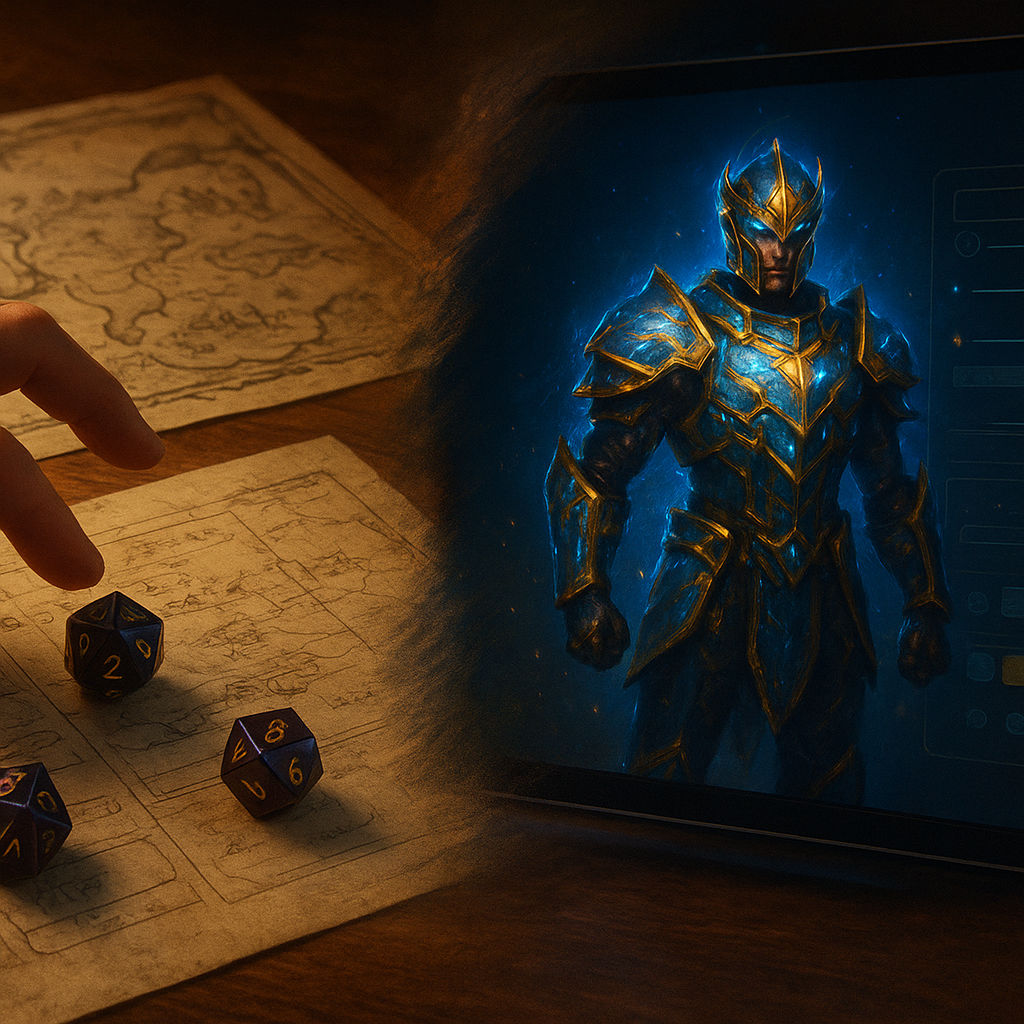
There’s something almost magical about sitting down to create a character before an adventure begins. Whether you’re rolling dice around a table lit by a single lamp, or spending three hours tweaking your avatar’s cheekbone structure before you’ve even seen the first cutscene, character customisation sits at the very heart of what makes roleplaying games so compelling. It’s the moment the game becomes yours.
But how did we get here? From pencil-and-paper stat blocks to real-time sliders that control everything from eye spacing to skin tone, the evolution of RPG character creation is a fascinating journey through game design philosophy, player psychology, and technological possibility. Let’s trace that path from the earliest dice rolls to the extraordinarily detailed digital avatars of today.
Who Invented Roleplaying Games? The Origins of Character Creation
The story begins — as so many great things do — in a basement. Gary Gygax and Dave Arneson are widely credited with creating Dungeons & Dragons in 1974, which is broadly considered the founding document of the roleplaying game genre. Arneson had been running a medieval wargame campaign called Blackmoor, and Gygax helped formalise and publish the system through TSR, Inc. What made D&D revolutionary wasn’t just the fantasy setting — it was the idea that each player controlled a single, persistent character with their own stats, history, and personality.
Character creation in early D&D was breathtakingly simple by modern standards. You rolled three six-sided dice for each of six attributes — Strength, Intelligence, Wisdom, Dexterity, Constitution, and Charisma — and whatever numbers fate handed you, you worked with. There was a beautiful, brutal honesty to it. Your fighter might be strong but dim; your wizard clever but physically fragile. The randomness wasn’t a flaw; it was the feature.
This dice-rolling approach established a foundational philosophy: constraint breeds creativity. When players couldn’t build their ideal character from scratch, they built around what they had — and that often produced more interesting, unexpected stories.
The First Video Game with Character Creation
When RPGs made the jump to computers, character creation came with them — albeit in a stripped-down form. dnd (1975), created by Gary Whisenhunt and Ray Wood on the PLATO computer system, is often cited as one of the earliest digital RPGs, drawing heavily from D&D’s ruleset. Shortly after, Pedit5 (also 1975) followed a similar template.
However, the game most commonly credited as the first mainstream video game with meaningful character creation is Ultima III: Exodus (1983), which allowed players to create a party of characters with different races, classes, and stat allocations. It brought the tabletop experience to the home computer in a way that genuinely resonated with players.
By the late 1980s and early 1990s, titles like Wizardry, Might and Magic, and the early Final Fantasy games were all exploring different approaches to letting players define who they played as. Some emphasised stat builds; others offered class selection; a few began experimenting with appearance options. The seeds of modern character customisation had been planted.
The 3 C’s of Game Design and Why Character Customisation Matters
In game design theory, the “3 C’s” typically refer to Character, Camera, and Controls — the three interconnected pillars that define a player’s physical relationship with a game world. Character is listed first for good reason: before a player can move through a world or interact with it, they need to feel connected to the entity doing the moving and interacting.
Character customisation is one of the most powerful tools designers have for building that connection. Research in player psychology consistently shows that the more agency players have over their avatar’s appearance and identity, the more emotionally invested they become in the game’s narrative. A 2019 study published in the journal Computers in Human Behaviour found that players who designed their own avatars reported significantly higher levels of immersion and emotional engagement than those assigned pre-built characters.

This is why RPGs — more than almost any other genre — lean so heavily into character creation. It’s not just a menu screen. It’s the first act of storytelling.
Mechanics vs. Aesthetics: Two Sides of Customisation
Modern character customisation generally operates on two distinct axes:
- Mechanical customisation — the choices that affect how the character plays: stats, class, skills, abilities, equipment, and builds.
- Aesthetic customisation — the choices that affect how the character looks: facial features, body type, hair, skin tone, clothing, and cosmetic details.
The balance between these two dimensions has shifted considerably over the decades. Early RPGs were almost entirely mechanical — visual representation was a small sprite that looked the same regardless of your choices. As hardware improved, aesthetics became increasingly central, to the point where some modern games spend as much development resource on character creators as on entire game systems.
Which RPG Has the Best Character Customisation?
This is one of those questions that ignites fierce debate in every gaming community, and for good reason — “best” depends enormously on what you value. That said, a few titles consistently rise to the top of these conversations.
Baldur’s Gate 3 — Mechanical Depth Meets Narrative Weight
Larian Studios’ Baldur’s Gate 3 (2023) is widely praised for combining genuine mechanical depth — rooted in D&D 5th Edition rules — with a character creator that allows for remarkable visual variety, including options for body type, skin colour, facial features, and even the character’s voice and backstory. Its approach respects both the tabletop heritage and contemporary expectations of visual representation.
Elden Ring and Dark Souls — Appearance as Identity
FromSoftware’s games are renowned for their nuanced character creators, which players use to craft everything from heroic warriors to deeply unsettling creatures. The detail on offer in Elden Ring (2022) is staggering, with granular sliders for virtually every facial feature. For many players, the character creator has become a game in itself, with communities sharing presets and tutorials online.
Dragon Age: Origins — Story-Integrated Creation
Dragon Age: Origins (2009) by BioWare took a different approach: character creation choices had direct narrative consequences. Your chosen race and background unlocked entirely different opening chapters, meaning the creation process wasn’t just cosmetic — it fundamentally shaped the story you’d experience. This remains one of the most ambitious implementations of character creation in RPG history.
Black Desert Online — The Gold Standard of Visual Customisation
If pure aesthetic customisation is the benchmark, Black Desert Online is frequently cited as the most technically impressive character creator in gaming. Its real-time, photorealistic rendering engine with hundreds of morphable sliders has been used by players to recreate celebrities, historical figures, and fictional characters with remarkable accuracy.
The Evolution of Representation in Character Creation
For much of gaming history, character creation systems reflected a narrow view of who games were for. Default options skewed heavily towards one particular demographic, and players outside that demographic — particularly those wanting to see their race, gender identity, or body type reflected in-game — faced significant limitations.

That has changed substantially, though the journey has been uneven. Games like The Sims series deserve particular credit for progressively expanding their customisation options; The Sims 4 notably moved away from binary gender options in 2016, allowing players to mix and match clothing, voice, and physical traits freely. Major RPG franchises have followed suit, with most contemporary releases offering a broad range of skin tones, body types, and gender-neutral options as standard.
This isn’t merely a matter of social inclusion — it’s also practical game design. A 2021 survey by Ubisoft found that players who could accurately represent themselves in games played for significantly longer sessions and were more likely to recommend the game to others. Representation and commercial success, it turns out, are not in tension.
Randomness Revisited: The Return of Dice Rolls
There’s a charming circularity to the fact that, just as games became capable of offering near-infinite customisation options, some designers started bringing back randomness. The rogue-like genre, which has exploded in popularity over the past decade, often uses randomised character attributes as a core mechanic. Games like Hades, Dead Cells, and Slay the Spire embrace the old D&D philosophy: work with what you’re given.
Even within traditional RPGs, there’s been renewed appreciation for constraint. Some players deliberately limit their customisation options — playing “blind” builds or random class assignments — as a way of recapturing the surprise and creativity that came with early dice rolls. The tabletop community has never abandoned this ethos; it remains fundamental to games like Pathfinder and the various editions of D&D still played around tables worldwide.
What the Future of Character Customisation Looks Like
Looking ahead, several technologies are poised to push character customisation into genuinely new territory:
- AI-generated appearances — Generative AI tools are already being used to create unique character portraits in games like Wildermyth, and the technology is likely to enable even more personalised avatar generation in future titles.
- Cross-platform avatar persistence — Platforms like Meta and various gaming ecosystems are exploring the idea of a single avatar identity that travels across multiple games and virtual spaces.
- Body scanning and facial capture — Some games already allow players to scan their own face using a phone camera; as this technology matures, truly photorealistic self-representation in games may become commonplace.
- Narrative-reactive creation — Building on what BioWare explored with Dragon Age, future RPGs may use character creation choices to dynamically generate unique story paths, dialogue, and world responses at a scale previously impossible. This kind of deep integration between player choice and open world game design represents one of the most exciting frontiers in the medium.
Conclusion
From the clatter of dice on a table in the 1970s to the hyper-detailed slider systems of contemporary RPGs, character customisation has always been about the same fundamental thing: making the experience feel personal. The methods have changed almost beyond recognition, but the underlying desire — to see yourself, or an idealised version of yourself, or a completely invented someone else, step into a world of adventure — remains constant.
The history of RPG character creation is also the history of gaming becoming more inclusive, more technically ambitious, and more psychologically sophisticated. The best character creators don’t just ask what your character looks like — they ask who your character is. And in answering that question, players often discover something about themselves too.
Whether you prefer the elegance of a single dice roll or the granular control of a hundred morphable sliders, one thing is certain: the way we build our digital selves will keep evolving, and it will remain one of the most quietly profound features in all of gaming.